

The Ig Nobel Prizes honor achievements so surprising that they make people LAUGH, then THINK. The prizes are intended to celebrate the unusual, honor the imaginative — and spur people’s interest in science, medicine, and technology.
(The image on the left is “The Stinker”, official mascot of the Ig Nobel Prizes)
Ceremonies
- The 36th First Annual Ig Nobel Prize ceremony, happened on September 3, 2026, in Zurich, Switzerland.
- The year’s ten new winners were introduced. A gaggle of amused Nobel laureates handed them the prizes.
- Read about why the ceremony moved to Europe.
- The 37th First Annual Ig Nobel Prize ceremony will happen on September 5, 2027, in Antwerp, Flanders, Belgium.
Some Upcoming Events
- EVENT: Ig Nobel Face-to-Face, Sunday, September 20, 2026, Miraikan Science Museum, Tokyo, Japan. Ig Nobel Prize winners will ask each other questions about their work
- EVENT: BOST-IG, Thursday evening, September 24, 2026, Swissnex, Cambridge, Massachusetts, USA — a celebration of past and new Ig Nobel Prizes, the songs of Tom Lehrer, the Museum of Bad Art, and American science.
- PLEASE NOTE: Here is the main message of the September 24 celebration in Massachusetts: The bizarre attacks on science will not utterly destroy science in the USA. American scientists and the American public, undaunted, both support and enjoy(!) the grand adventure of science.
- Other events are listed on our UPCOMING EVENTS page.
INFO
- Details of past winners and past ceremonies are in the Past Winners list and the Ig Archives.
- —> You can add yourself to the Ig Events mailing list.
- Keep yourself current with news items in the blog.
- Read some press reports about the Ig
The Ceremony
The Ig Nobel Prize ceremony is a gala mix of awards ceremony, circus, opera, and many other things. The Ig Nobel Prizes are physically handed to the winners by genuine (and genuinely bemused) Nobel Laureates. Every year since 1996, the ceremony has also included the premiere of a new mini-opera (or opera songs) about some subject related to science.

The Ig, As Seen by Others
“The Ig Nobel awards are arguably the highlight of the scientific calendar“, said Nature magazine in 2004, and two decades later, in 2026, said in an editorial:
Why the super-fun Ig Nobel prizes bring serious value to science
…. The Ig Nobels are irreverent and often surreal, not unlike a lot of laboratory humour. They radiate a love for scientific knowledge while simultaneously sticking pins into academic hierarchies. Such light-hearted self-deprecation is key to why the Ig Nobels still feel fresh in their fourth decade. The ceremony is where science is celebrated, researchers are respected and the pursuit of prestige for its own sake has no place. Scientists need such camaraderie and mutual support now more than ever.
In 2026, also, The Economist interviewed many winners and organizers, about what the Ig means to them. In 2024 Nature interviewed [and made a podcast about] some winners about how the prize has affected their careers. CNRS, the French research organization interviewed some of the many French past Ig winners. The Science History Institute podcast poked deeply into “The Dignity of the Ig Nobels”.
Indulge yourself, please, by wandering through some of the many press reports about the winners and the ceremony collected on our Press Clippings page. For some juicy historical perspective, you might begin by reading a Wall Street Journal article about the Igs, published on October 10, 2003.
Some History of the Ceremony
THE FIRST 35 YEARS: The First Annual Ig Nobel Prize ceremony happened in 1991 at the MIT Museum in Cambridge Massachusetts. The 1992, 1993, and 1994 ceremonies happened in MIT’s Kresge Auditorium. In 1995 the ceremony moved across town, to Harvard University, where it happened very year until the Covid pandemic in 2020 rendered in-theater events impractical. The Ig Nobel Prize ceremonies during the first four pandemic years (2021-2023) happened exclusively online (and included an innovative way for a person located on one continent to hand a physical object — an Ig Nobel Prize — to a person on a different continent). In 2024 the ceremony returned to MIT. In 2025 the ceremony was held at Boston University.
THE BIG MOVE: In 2026, the ceremony moved to Europe, The 202 ceremony happened in Zurich, Switzerland, in collaboration with institutions of the ETH domain and the University of Zurich. Here are details about the what and why of the move. For the future, the general plan is to hold the ceremony in Zurich, Switzerland in even-numbered years (2026, 2028, etc.). Each interim year — each odd-numbered year —the ceremony will be hosted in a different country.
BROADCASTING. The ceremony has been webcast every year, beginning in 1995. That 1995 ceremony was one of the very first events video-broadcast on the internet. In the USA, every year since 1992,a specially edited recording of the ceremony has been radio broadcast on the day after Thanksgiving, on public radio’s “Science Friday” program,
(For some especially detailed history, see Russian science journalist Dmitry Borisov’s 2024 comprehensive history of the Igs, in the publication N+1. It’s written in the Russian language, which you can if need be machine-translate into English or many other languages.)

How to Nominate Someone (or a Team) for an Ig Nobel Prize
The nomination process is simple and informal. Essentially: tell us what they did, and point us to clear documentation. (Here’s more detail, if you’d like it.)
For more info, see the list of Ig Nobel Prize winners, and also the Archives (videos and details of past ceremonies)
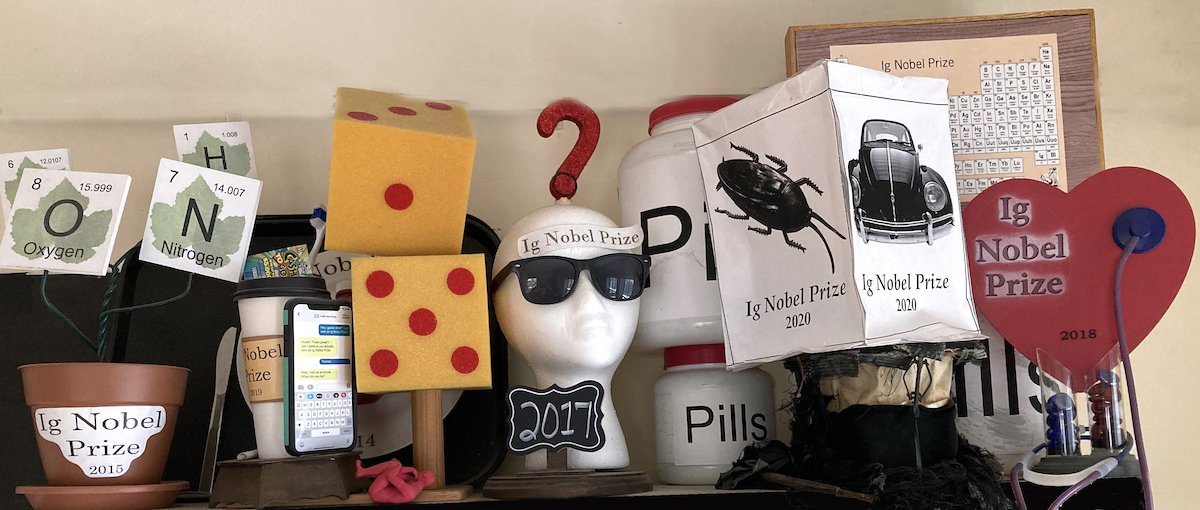
“Last, but not least, there are the Ig Nobel awards. These come with little cash, but much cachet, and reward those research projects that ‘first make people laugh, and then make them think'” — Nature
Get an email reminder when the next Ig Nobel ceremony is approaching. Enter your E-mail (to join our private E-mail list):
Books About the Igs
The photos below shows some of the books people have written about, or mostly about, the Ig Nobel Prizes.

Upasana Sarraju’s Unruly: The Ig Nobel Prizes and The Science That Refuses to Behave published by India Penguin, ISBN 9780143470403] was published in February, 2026.

Kiyoshi Furusawa’s Laugh and think! The Ig Nobel Prize Encyclopedia [ISBN 9784593100453] is a treat for children and also for former children.
There are many more. Some are shown in the photo below (Ig Nobel Prize Fan Book is an ongoing, long-running series, written by fans in Japan). If you know of others, please tell us about them!

Ig Nobel founder Marc Abrahams, too, has written some books. Those books have been translated into many languages.


This and That
“The world of science has become so specialized today that amazing, parodic, and improbable topics are almost inevitable. And these too often cry out for prestigious awards. Especially if they prove to be useful.” — Robert Kovacs’s report in the Hungarian publication Index.
Journalist Patricia Fernández de Lis, in the Spanish newspaper El País, discussed with the Ig Nobel founder why the prize ceremony is moving to Europe.
“What’s it like to win an Ig Nobel Prize?” The Audacity radio program interviewed several winners, asking that very question.
“Who are the Ig Nobel Prize Winners? The Ig Nobel Prize looks like a mockery, but it makes you think“, begins Zoran Radovanović’s lovely essay (in Serbian) published in Velike Priçe.
“Let us also admire the dedication of these researchers of the strange“, says Nicolas Méra’s essay about the Igs, in Slate magazine.
The prizes and the winners both provide and inspire many adventures. Here, for example, is a 2020 gathering of Japanese Ig Nobel Prize winners and their dreams, on NHK-TV:
Here is an animated tribute, by the New York Times for Kids, China, to the 2020 Ig Nobel Prize ceremony:
2022: A Prize for the Prize!
The 2022 Heinz Oberhummer award, for “outstanding science communication”, was awarded to the Ig Nobel Prize, in a gala in Vienna, Austria. The gala was webcast. Here’s recorded video of it:
Donate to the Igs
The Ig has long been one of the world’s favorite science-related events. It has also always been funded, alas, on the thread of a shoestring. Your contribution, no matter what size, will be deeply appreciated. Donate to the Igs – Improbable Research
Frequently Asked Questions
What’s the point of this? — To help people discover things that are surprising— so surprising that those things make people LAUGH, then THINK.
Who organizes the Ig Nobel Prizes? — The Ig Nobel Prizes are organized by the magazine Annals of Improbable Research.
Who has won this prize? — Ten new Ig Nobel prizes have been awarded each year, beginning in 1991. The winners page contains a complete list.
How do I find out about past years? — The Ig Archive page collects details, videos, and links from past ceremonies.
What are the Ig Informal Lectures? What Is Ig Nobel Face-to-Face?— At the ceremony itself, the new winners are given only 60 seconds to explain themselves. So… two days later, on Saturday afternoon, they get more time, with an informal audience brimming with eager questions. For many years, this Saturday event was called “The Ig Informal Lectures”, in which the new winners would give short talks. In recent years, the Saturday event has had a different form: Called “Ig Nobel Face-to-Face”, it has the winners gather on stage and aske each other questions about their work.
How do you find new winners? — The Ig Nobel Board of Governors is always looking at lots of things. News reports, research journals, old books, trolling through databases, talking with people. But far more than that, anyone can send a nomination, and in a typical year we get something like ten thousand nominations. Whatever is not chosen gets considered again in future years.
How do I nominate someone (or a team) for an Ig Nobel prize?—Send nominations (please include clear documentation, or a link to clear documentation) to <marc atttttt improbable dotttttt com>.
Has anyone ever turned down this award? — Almost always, we contact the chosen individuals (or teams) in advance, quietly, to offer the prize and give them the option to decline this great honor. If someone declines, we simply, privately withdraw the offer. Happily, nearly everyone who is offered an Ig Nobel Prize decides to accept, and also decides to come be part of the ceremony.
Are you ridiculing science? —No. We are honoring achievements that make people laugh, then think. Good achievements can also be odd, funny, and even absurd; So can bad achievements. A lot of good science gets attacked because of its absurdity. A lot of bad science gets revered despite its absurdity.
Are those real Nobel Laureates handing out the prizes?— Yes. At every Ig Nobel Prize ceremony, genuine Nobel Laureates physically hand out the prizes, and participate in the ceremony in other ways.
How can I get involved with the next ceremony? — If you or your organization are comfortable publicly demonstrating both a love of science and a sense of humor, please getin touch with us. We are (almost) always happy to collaborate with volunteers, sponsors, and supporters.
Is there any interesting press coverage about the Igs? — The Press Clips page has links to some press reports about the Igs.
What if I would like to read about the Igs in book format? —There are many books about the Ig Nobel Prizes and several of these have been translated into other languages. Many of the winners have written books, and many of those winners are also the subjects of books. Many of them have given TED talks, too.
What if I’d like to see the ceremony live, but can’t make it to Cambridge, Massachusetts? —You can watch the live broadcast each year here on the Improbable Research website, and you can watch videos of past ceremonies anytime. We present other events throughout the year and around the world that (we hope) make people laugh and then think. Find a list of our upcoming events (including the annual Ig Nobel EuroTour).
What might happen when you win an Ig Nobel Prize? This entrancing, well-researched article (in New York magazine) by Kerry Howley tells what happened to and because of scientist Saul Justin Newman after he was awarded a prize in 2024. (What happened? Hint: people noticed.)
Is there a pattern in the prizes you have awarded? — We judge nominations based on whether they make people laugh, then think. That is the only criterion. No other pattern is intended. Of course, human beings are surprisingly good at seeing (or imagining!) patterns, even in random collections of data.
Here are a few of the myriad of photographs and videos from past ceremonies.
CBC News sent a crew to the 2006 ceremony:

This photo shows the 2009 Ig Nobel Prize winners, joined by nine amused Nobel laureates, take a bow as the ceremony concludes. (Photo: Richard Baguley)

2004 Ig Nobel Peace Prizewinner Daisuke Inoue — the inventor of karaoke — is serenaded by Nobel Laureates Dudley Herschbach (left), Richard Roberts and William Lipscomb, and by Studmuffins of Science creator Dr. Karen Hopkin. Listen to NPR’s report.
The Japanese public TV network NHK created this documentary about the Igs in 2002:
The Ukrainian INTER TV network sent a crew to the 2010 ceremony. Click here to see their report.
Dutch filmmaker Bahram Sadeghi made six mini-documentaries, each about a different Ig Nobel Prize winner. Here is the first:
Andy Jordan of the Wall Street Journal attended the 2008 Ig Nobel Prize Ceremony, and brought his videocamera:
CBS News profiled the 2006 Ig Nobel Prize winners. Click the image above to watch.

2009 Ig Nobel Public Health Prize winner Dr. Elena Bodnar demonstrates her invention — a brassiere that, in an emergency, can be converted into a pair of protective face masks — assisted by Nobel laureates Wolfgang Ketterle, Orhan Pamuk, and Paul Krugman. Click the image above to watch.

The Russian network NTV traveled the world to interview Ig Nobel Prize winners. Their ten-minute report was originally broadcast in December 2007. The image here shows an NTV reporter visiting the (Literature Prize-winning) Nudist Research Library in Kissimmee, Florida.
WCVB’s Chronicle program did a five-minute introduction to the Ig in 2009. Click the image above to watch it.
An Associated Press visit to the 2012 Ig Nobel Prize ceremony: