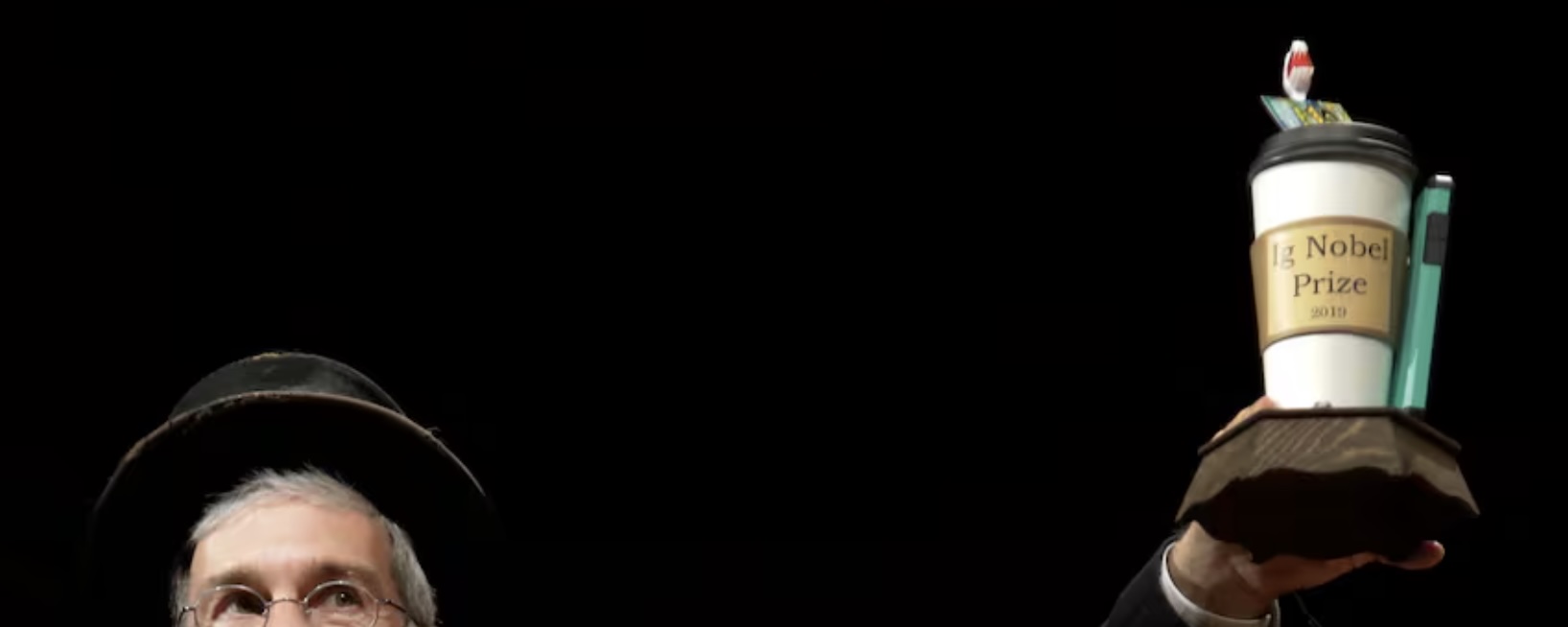
Patricia Fernández de Lis of the Spanish newspaper El País interviewed me about the Ig Nobel Prize ceremony moving to Europe. Here is the interview machine-translated into English. The original version, in Spanish of course, is on the El País web site.
Marc Abrahams, founder of the ‘joke Nobel Prizes’: “Scientists in the US are very angry. People are waking up.”
The prestigious Ig Nobel Prizes are moving to Switzerland because their founder believes he can no longer guarantee the safety of the winners in the United States.
“More than a million people have watched Marc’s TED Talk. More than 7 billion haven’t.” Marc Abrahams’s profile page on the website of the community he runs, Improbable Research , offers clues about who he is and how a sense of humor governs his life. A Harvard-trained mathematician, Abrahams (Newburyport, USA, 70 years old) founded Wisdom Simulators, a company that used computers to let people practice making impossible decisions. In other words, before the Ig Nobel Prizes, he was already obsessed with improbability.
The Ig Nobel Prizes are pronounced as they are spelled; a play on words combining the famous Nobel Prizes and the word ” ignoble .” Abrahams created the awards in 1991 and has been their driving force and master of ceremonies for all 35 editions. All the winning studies (such as disguising cows as zebras to avoid fly bites, getting worms drunk , or creating a toilet to record and analyze feces in real time) share one trait: they are improbable, unexpected, but that doesn’t mean they aren’t good science. A study that won an Ig Nobel Prize in 2006 —that the malaria-carrying mosquito is just as attracted to Limburger cheese as it is to the smell of human feet—had a direct consequence: traps using that cheese were placed in strategic areas of Africa to combat the epidemic. And an Ig Nobel laureate , André Geim, awarded for using magnets to levitate a frog and a sumo wrestler, won a real Nobel Prize 10 years later.
The Ig Nobel Prize ceremonies, a lively affair, are attended by real Nobel laureates and have been held in prestigious locations such as Harvard University, the Massachusetts Institute of Technology (MIT), and Boston University—always in the US. But this year, the ceremony is moving to Switzerland because the US “has become unsafe” for the laureates , the organization announced on Monday. Abrahams spoke with EL PAÍS via video conference after a couple of very busy and emotional days. The man, who has spent 35 years celebrating the improbable, is now facing something he never imagined: that the impossible—that the US has become a hostile place for science —is actually happening.
Question: When and why did you start thinking about moving the Ig Nobel Prizes out of the US?
Answer: Actually, the process had two very distinct stages. I founded the Ig Nobel Prizes in 1991, and it has grown with the help of many people all over the world. I’m not young, and I wondered how to ensure the project would continue when I was gone. Last year, during a dinner in Switzerland, I asked that question to one of the guests, who holds a very high position in academia and government. And we started making plans to create a foundation in Europe. That’s the sweet part of the story.
Q. And the not-so-sweet part?
R. At the ceremony last September, as always, there were 10 winners. Almost every year they all manage to come, even though we don’t have the money to pay for their travel. But in 2025, things in the United States were already getting very difficult . I was surprised that nine of the 10 said they did want to come, despite everything. The tenth said he was happy to receive the prize, but that he absolutely would not travel to the United States, and that he was very angry about what was happening. That’s understandable; if someone can’t come, we ask someone else to accept the prize and read their speech. But in the week leading up to the ceremony, three other winners, seeing how things were developing, decided it wasn’t safe to travel. Suddenly, only six of the 10 were present. For the other four, we asked the Nobel laureates to read their speeches while we projected a large photo of each of them onto the stage. It worked quite well. But since then, things have gotten much worse , and it became very clear that people simply shouldn’t travel here. It’s not safe .
Q. How did Boston University react to the decision?
R. With sadness that the ceremony is leaving, but also with a lot of support. We will still hold an event there this year, three weeks after the Zurich ceremony. We don’t want anything to be destroyed here.
Q. Was it an easy or painful decision for you, after 35 years in Massachusetts?
R. I still live here and will continue to live here, and I’ll travel more. But yes, I’m sad that the ceremony is no longer here. We’ve done it 35 times, and each one was magical. The magic will still happen, just not here. We’ll keep some things going and grow what we can. It seems like it will be many years before the ceremony can be held again in the United States.
Q. You say the situation in the United States is not safe. What exactly is happening with science in your country?
R. In general terms, it’s extremely worrying. The immediate future here will be very, very complicated. Many careers are being destroyed , others are being prevented, and a great deal of ongoing research has already been halted . I could talk about it for hours. That said, some good things are going to happen as a result of all this. In many parts of the world, people are realizing that they can do things on their own, without always having to go to the biggest place [referring to the US]. It’s like seeing many small seeds that were in the ground begin to sprout when spring arrives. But in the United States, we don’t know what’s going to happen. A few days ago, there were large demonstrations for science all over the country . I gave a talk at the one in Boston. Four Nobel laureates participated. The change has been very remarkable: last year, at a demonstration in the same place, the scientists who spoke were scared and confused. This year, they were all very angry and very determined to act.
Q. And what can they do?
R. Many of those working in biology and medicine say they can’t do science. Their funding has been cut, their labs are being shut down, and students with the best ideas can’t afford to live. It’s terrible. And some are leaving for other countries. This is a potentially extraordinary moment for Spain and for any other country with a long history of good science. People are waking up and realizing that Spain is a great place to do research.
Q. Can humor solve something that serious protests might not be able to?
R. Yes, in two ways. First, it can spark interest. If you’re laughing at a discovery, you’re paying attention to it, and then you become interested. And for the rest of your life, you might remain interested and want to know more. I think that’s the real power of the Ig Nobel Prizes. The other aspect of humor—and many scientists say this too—is that science is a very difficult and frustrating profession. It’s one of the few where you know, as a given, that most of what you do is going to fail. And if you have a sense of humor, that helps tremendously. It helps you keep going, stay positive, and make sure you persevere so that, sometimes, you succeed.
Q. When you founded the awards in 1991, did you think they would last 35 years?
R. I thought I had a chance, but you never know. It all started because a year earlier I asked myself a question that had been nagging at me. Since I was little, I collected stories and I liked to write about science and fun things, but I never saw any adults who did it professionally. I did other things: math, computer science. One day I asked myself: what would happen if I tried to publish something? And I answered myself: how will I feel if I’m lucky enough to live a long time, say to 95, and I ask myself that same question? If the answer is “I don’t know because I never tried,” I’ll become a very grumpy old man.
Q. How did you go from there to winning awards?
R. Very quickly. I started meeting a lot of inventors, a lot of scientists, and I kept thinking: nobody knows these people, and nobody ever will. They’re going to live their lives and be forgotten. And that’s wrong. Something has to be done. So we organized a little ceremony. By then, I knew quite a few famous scientists and asked them to come. I also knew a lot of journalists. And we used the internet, when I was still very young, to put out a notice: “The first annual Ig Nobel Prize ceremony will take place at MIT.” Admission was free, but you had to pick up a ticket on a Tuesday morning. All the tickets were gone. All the time I thought, and I’m pretty sure everyone else did too, that at any moment some adult would come in and tell us to stop and go home. But nobody did. And the next day, there were reports about it all over the world.
Q. Is there any award you remember with particular fondness?
R. There are many, in different senses, but one that always comes to mind is the 2003 Biology Prize, for the discovery of homosexual necrophilia in mallards. When you tell someone about it, each word changes the meaning of the story: necrophilia… homosexual… And when you get to the last word, ‘mallard,’ the reactions change. But the article itself is a spectacular piece of writing , beautifully narrated, like something out of Edgar Allan Poe. The story is completely absurd, and yet it’s well-documented.
Q. How do you see the Ig Nobel Prizes in 35 years?
R. I hope they continue to grow, and that people organize small and large events in more countries and more places. And that they use the essence of the Ig Nobel Prizes to get peole to pay attention to things they thought they’d never care about.