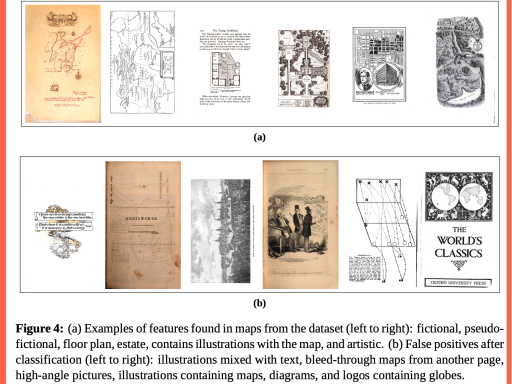
If you meet a person who reads novels, and who has mentioned to you that some of those novels include a map, consider mentioning to to that person that they can read a study about the question of why there are or are not maps in some novels. The study is: “Castles, Battlefields, and Continents: […]
Tag: novels
Nit-picking Robinson Crusoe; Wrong cocktail; Baby radar; Much-lettered
This week’s Feedback column (that I write) in New Scientist magazine has four segments. Here are bits of each of them: Nit-picking literature — Little things bother some people. Elizabeth Kowaleski Wallace wonders why little things failed to bother Robinson Crusoe, the hero of Daniel Defoe’s 1719 novel, who spent 28 years documenting his plight as a castaway […]
Algorithmic Distinguishing of Novelists from their Punctuation Patterns
Adam J. Calhoun has written a wonderful blog entry that illustrates, with some great data visualization, that it is possible to algorithmically distinguish different novelists based only on their punctuation habits. The idea is simple: just remove all words from a corpus of text and look at the patterns of the punctuation. Here is an illustration. […]
How to write a book semi-automatically
To semi-automatically compose a non-fiction book, or several hundred thousand of them, one can observe the methods of Professor Philip M. Parker (of INSEAD), of whom we have written (semi-automatically) many times. To semi-automatically compose a work of fiction, one can learn much by reading Michelle Legro’s essay in Brain Pickings. It begins: Plotto: The Master Book […]

