Hair counters count hairs. Scalp-hair counters can and maybe should celebrate that this year, 2026, is the fortieth anniversary year of the publication of one of the most treasured studies of how to improve one’s ability to count scalp hairs. That study is:
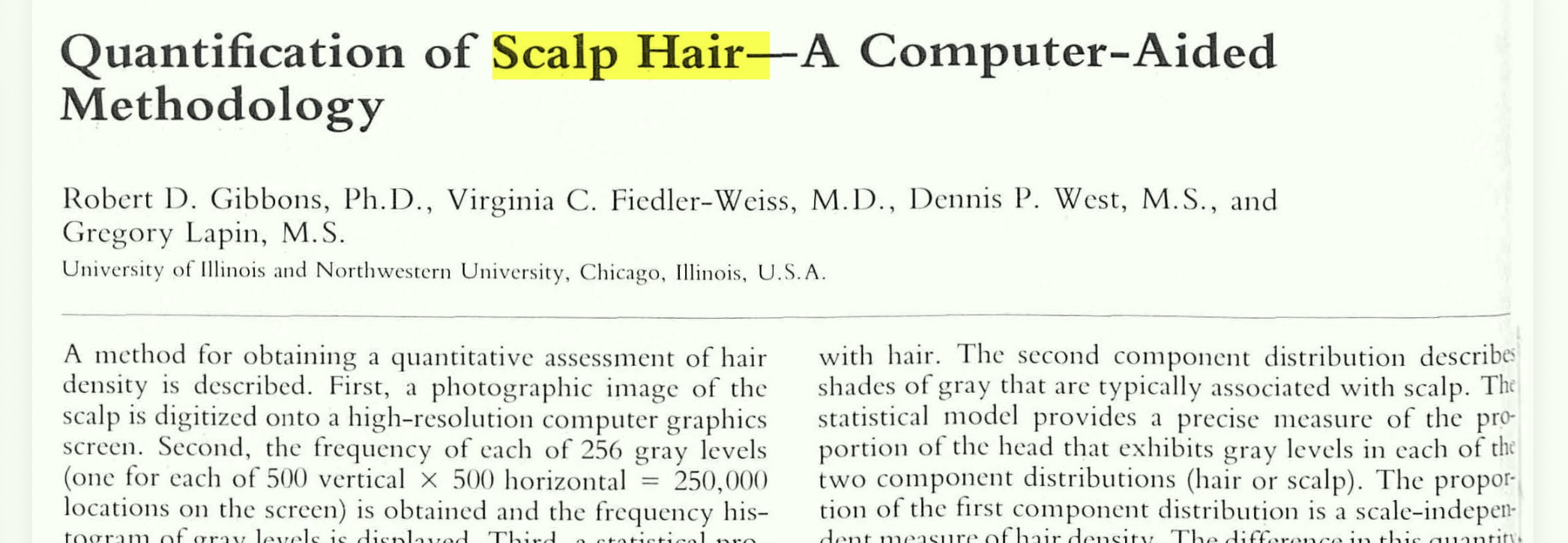
“Quantification of Scalp Hair — A Computer-Aided Methodology,” Robert D. Gibbons, Virginia C. Fiedler-Weiss, Dennis P. West, and Gregory Lapin, Journal of Investigative Dermatology, vol. 86, no. 1, 1986, pp. 78-82. The authors report:
“A method for obtaining a quantitative assessment of hair density is described. First, a photographic image of the scalp is digitized onto a high-resolution computer graphics screen. Second, the frequency of each of 256 gray levels (one for each of 500 vertical × 500 horizontal = 250,000 locations on the screen) is obtained and the frequency histogram of gray levels is displayed. Third, a statistical procedure, gaussian mixture analysis, is used to resolve the frequency distribution into two normally distributed component distributions.”
Nasal Hair Counting
Hairs grow elsewhere on the human body, too. Nasal-hair counters can perpetually celebrate the awarding, in 2023, of that year’s Ig Nobel Medicine Prize to to Christine Pham, Bobak Hedayati, Kiana Hashemi, Ella Csuka, Tiana Mamaghani, Margit Juhasz, Jamie Wikenheiser, and Natasha Mesinkovska, for using cadavers to explore whether there is an equal number of hairs in each of a person’s two nostrils.
REFERENCE: “The Quantification and Measurement of Nasal Hairs in a Cadaveric Population,” Christine Pham, Bobak Hedayati, Kiana Hashemi, Ella Csuka, Tiana Mamaghani, Margit Juhasz, Jamie Wikenheiser, and Natasha Mesinkovska, International Journal of Dermatology, vol. 61, no. 11, November 2022, pp. e456-e457.
