The California inventor (and Taser Corporation director) of a telephone for animals and a cell phone that reaches out and shocks bad guys, borborygmi (the sounds made by your intestines), the phrase “I don’t know”, and other things turn up in this week’s Improbable Research podcast.
SUBSCRIBE on Play.it or iTunes, to get a new episode every week, free.
[NEWS: Soon, the podcast will also be available on Spotify.]
This week, Marc Abrahams tells about:
- Telephones for animals. (“Domestic animal telephone“, US patent granted to Mark W. Kroll, # 7654230, granted February 2, 2010. Featuring dramatic readings by Melissa Franklin.)
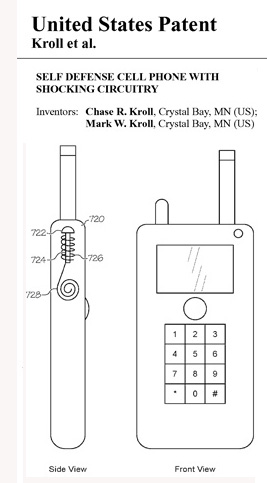
- Self-defense cell phone. (“Self defense cell phone with shocking circuitry,” US patent US7986965, issues July 26, 2011 to Chase R. Kroll and Mark W. Kroll. / “Essentials of low-power electrocution: Established and speculated mechanisms,” Mark W. Kroll, R. M. Fish, D. Lakkireddy, R. M. Luceri, and D. Panescu, in Engineering in Medicine and Biology Society (EMBC), 2012 Annual International Conference of the IEEE, pp. 5734-5740. IEEE, 2012. / TASER International, Inc. / Featuring dramatic readings by Daniel Rosenberg.)
- Improbable Medical Review. (“Accidental Mobile Phone Card Ingestion,” Sudesh Dixit, Jayanand Mekwan, and Nigel F. Brayley, Emergency Medicine Journal, vol. 24, 2007, p. 142 / “Ingested Foreign Bodies and Societal Wealth: Three-Year Observational Study of Swallowed Coins,” P.G. Firth, H. Zheng, and J.A. Biller, BMJ, vol. 341, 2010. / “Reversing Brow Lifts,” M.J. Yaremchuk, N. O’Sullivan, and F. Benslimane, Aesthetic Surgery Journal, vol. 27, no. 4, July–August 2007, pp. 367–75. Featuring dramatic readings by Maggie Lettvin.)

- What Your Gut Says, Psychoanalytically. (“New Observations on Body Organ Language,” Christian Muller, Psychotherapy and Psychosomics, vol. 42, nos. 1–4, 1984, pp. 124–6 / “Borborygmi as Markers of Psychic Work During the Analytic Session: A Contribution to Freud’s Experience of Satisfaction and to Bion’s Idea About the Digestive Model for the Thinking Apparatus,” International Journal of Psycho-Analysis, vol. 71, 1990, p. 641–59. / “The Emergence of Thinking: Bion as the Link Between Freud and the Neurosciences,” Guy Da Silva, in M. Grignon (Ed.) Psychoanalysis and the Zest for Living: Reflections and Psychoanalytic Writings in Memory of W.C.M. Scott, ESF Publishers, Binghamton, NY, 1998. / “Le Modèle Alimentaire dans la Théorie de la Pensée de Bion: Suivi d’une Application de ce Modèle dans l’Analyse d’un Patient,” Guy Da Silva, Symposium of the Société Psychanalytique de Montréal, Spring 1992. Featuring dramatic readings by Jean Berko Gleason.) BONUS: In this video, a woman records her borborygmi:
- Improbable Research Review. (“Prehension of Half-Full and Half-Empty Glasses: Time and History Effects on Multi-Digit Coordination” Yao Sun, Vladimir M. Zatsiorsky, and Mark L. Latash, Experimental Brain Research, vol. 209, 2011, pp. 571–85. / “A Corpus Comparison of the Use of I Don’t Know by British and New Zealand Speakers,” Lynn E. Grant, Journal of Pragmatics, vol. 42, 2010, pp. 2282–96. / “The Moss from the Tyrolean Iceman’s Colon,” James H. Dickson, Journal of Bryology, vol. 19, no. 3, 1997, pp. 449–51. Featuring dramatic readings by Melissa Franklin.)
The mysterious John Schedler perhaps did the sound engineering this week.
The Improbable Research podcast is all about research that makes people LAUGH, then THINK — real research, about anything and everything, from everywhere —research that may be good or bad, important or trivial, valuable or worthless. CBS distributes it, both on the new CBS Play.it web site, and on iTunes (and soon, also on Spotify).