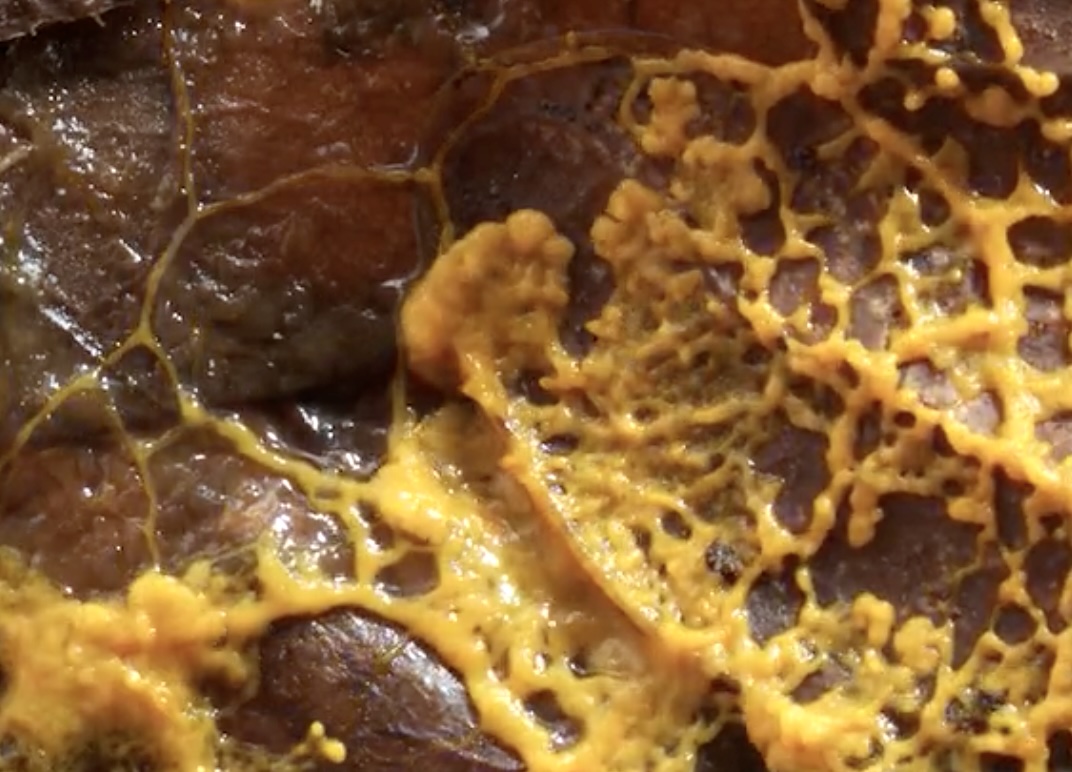
“ ‘This is dangerous’: slime moulds and the bitter debate over the nature of intelligence — Scientists are battling over whether supposedly simple organisms should be considered ‘intelligent’. The outcome could reshape our understanding of the natural world – and our own place within it”. So says the headline of a report by Samanth Subramanian, in The Guardian, on September 8, 2026. The report begins:
Forty years ago, as an undergraduate in Hokkaido, Toshiyuki Nakagaki came upon a lemon-yellow stain in a petri dish. That encounter turned him into a doyen of slime mould research – and fed a storm of biological and philosophical debate about the meanings of life and intelligence that persists to this day. Before, no one would have called a slime mould “intelligent”; the popular adjective, in fact, was “simple”. “A simple mass of protoplasm,” one 1895 description ran; “among the most simple of organisms”, said another. And it was hard to argue otherwise. A slime mould can appear to be just a small cell, capable only of feeding and reproducing. Simple is as simple does…
In doing all this, the mould displayed such a verve for efficiency – no wasted motion, an optimal pursuit of its food – that it ended up nearly retracing the route map of the greater Tokyo area’s railway system. Nearly, Nakagaki said – because, in fact, free of human bias or politicking, Physarum may have improved the design of the network. Later, when Nakagaki twice won the Ig Nobel – the prize for research that is both amusing and thought-provoking – the first award cited his maze paper in the field of “cognitive science”, but the second, cheekily, hailed the Tokyo railway study as a breakthrough in “transportation planning”.
NHK World recently featured that research, in a video documentary:

And Further Ig Nobel Connections: Toshi Nakagaki
Since winning those two Ig Nobel Prizes, Toshi Nakagaki has often assisted the Ig Nobel Board of Governors in finding and making first contact in offering Ig Nobel Prizes to newly selected winners.
Nakagaki was awarded the Ig Nobel Cognitive Science Prize in 2008, with Hiroyasu Yamada, Ryo Kobayashi, Atsushi Tero, Akio Ishiguro, and Ágotá Tóth, for discovering that slime molds can solve puzzles.
Two years later, he was awarded the Ig Nobel Transportation Prize in 2010, with Atsushi Tero, Seiji Takagi, Tetsu Saigusa, Kentaro Ito, Kenji Yumiki, Ryo Kobayashi, Dan Bebber, and Mark Fricker, for using slime mold to determine the optimal routes for railroad tracks.
And Further Ig Nobel Connections: Dany Adams
Michael Levin is the other scientist most profiled in that Guardian article. Levin was for many years the research partner of biologist Dany Adams, who made one of their most famous discoveries.
Dany Adams has for many years been one of the main organizers of the Ig Nobel Prize ceremony. Most lately, she and Susan Kany organized much of the diplomatic and volunteers activity that made the 36th First Annual Ig Nobel Prize ceremony, in Zurich, Switzerland, hum, buzz, and joyously zing.
This video, made a while ago as part of the World Science Festival, shows Adams discussing some of her research: