Whether you prefer to be eaten or to eat, you can pretend to indulge your preference by doing what the people in this study did:
“Impersonating Predators and Prey to Study Trophic Interactions Through Real-Life Simulations,” David Bolduc, Frédéric Dulude-de Broin, Gabriel Bergeron, Catherine Villeneuve, Matthieu Weiss-Blais, Clément Couloigner, Rachel Dubourg, Maxime Fraser-Franco, Francis Banville, Louis Moisan, Pierre-Olivier Montiglio, Daniel Fortin, François Thibault, Antoine Allard, Camille Gaudreau-Rousseau, Irene Roca, Audrey Durand, Clément Massé, Emmanuelle Barreau, Tamara A. Hiltunen, Emily Madsen, Mathilde Lapointe St-Pierre, Alexandra Engler, Akiko Kato, Morgane Le Goff, Maria Isabel Arce-Plata, Norma Rocio Forero-Muñoz, Sophie Gallais, Dominique Gravel, and Pierre Legagneux, Methods in Ecology and Evolution, vol. 17, no. 1, January 2026, pp. 158-171. The authors explain:
As a compromise between mathematical and observation-oriented methods, we introduce an original approach based on an outdoor game. In this game, biologged human players follow simple rules to impersonate predators and prey in a natural landscape augmented with synthetic resource patches and refuges. We investigated the behaviour, movement, functional response and spatial organization of over 25 players simultaneously monitored during nine simulations to determine whether the game could replicate realistic predator–prey dynamics.
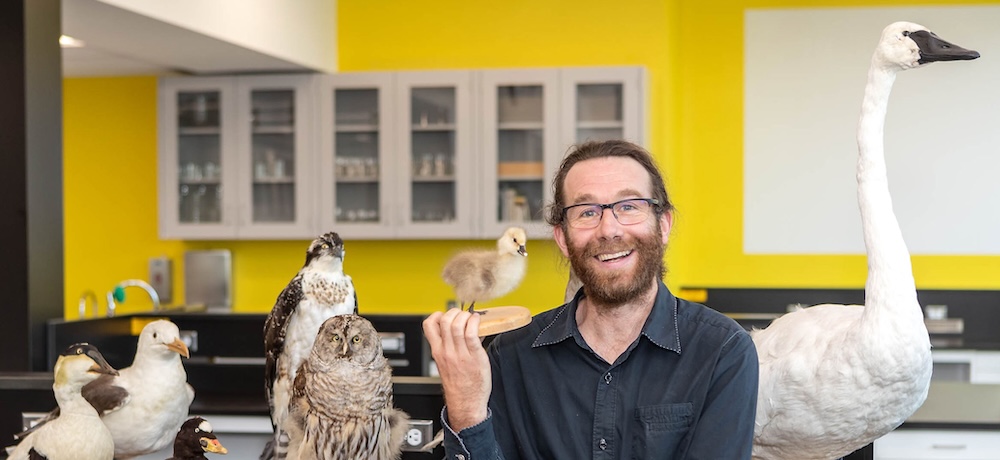
This photo shows study co-author Pierre Legagneux: