How Many Slices Does a Mandarin Have?
A Three-Year Household Investigation Conducted Under Conditions of Seasonal Citrus Oversupply
by David Balmer¹, Gabriel Balmer¹, Siegfried Hapfelmeier², Maria Luisa Balmer²*
¹ Citizen scientists, ² Institute for Infectious Diseases, University of Bern, Switzerland, *Corresponding author
Abstract
During the European winter months, mandarins and oranges achieve near-monopolistic status in the household fruit economy, a situation that has been known to test the patience of fruit-consuming populations. Motivated by repeated exposure to these peelable spheres, many of which are now conveniently seedless and accessible even to small children, we investigated whether mandarins reliably contain the same number of edible segments. Over three citrus seasons (2023–2026), we counted segments in 133 mandarins obtained through routine shopping and seasonal gift influx (including possible contributions from Santa Claus). Segment numbers ranged from 7 to 13, with a pronounced mode at 10 and a mean of 9.79 ± 1.20. Remarkably, this distribution was stable across all three years and closely matches reports from the late 20th century, suggesting that decades of aggressive citrus breeding have successfully removed seeds and improved peelability and taste without substantially perturbing internal architecture. We conclude that mandarins are developmentally conservative objects whose segment numbers vary modestly but stubbornly resist dramatic innovation.

Introduction
Many biological structures display pleasing numerical regularities. Flowers, for example, often exhibit fixed numbers of petals, a phenomenon that has reassured botanists for centuries and provided schoolchildren with something reliable in an otherwise unpredictable world.
Mandarins (Citrus reticulata and relatives) present a superficially similar repeated structure: the familiar edible “slices.” These segments correspond to carpels formed during floral development (Spiegel-Roy & Goldschmidt, 1996). Popular descriptions typically claim that mandarins contain “about 9–11 segments,” but quantitative data from real-world consumption settings remain surprisingly sparse. Our interest in this question was not initially academic. During the winter months in central Europe, mandarins and oranges become so abundant that they are, at times, perceived as the only fruit available. This seasonal citrus saturation, combined with the modern advent of conveniently seedless and child-peelable varieties, created both opportunity and mild exasperation, conditions historically known to promote scientific inquiry.
A further conceptual puzzle emerged. Flowers often maintain strict organ numbers. Mandarins, however, appear less disciplined. This raises a developmental question of some interest: when variation occurs, do mandarins preferentially split segments or fuse them? To address these issues, we conducted a longitudinal household survey of mandarin segment number across three consecutive citrus seasons.
Materials and Methods
Study design
We performed a prospective observational study across three citrus seasons (2023/24–2025/26) in a single European household exposed to routine winter citrus conditions.
Fruit acquisition
Mandarins and mandarin-like citrus fruits were obtained through standard supermarket purchases and seasonal gift channels. Provenance therefore likely included multiple cultivars, producers, and possibly one or more benevolent North Pole supply chains.
Segment enumeration
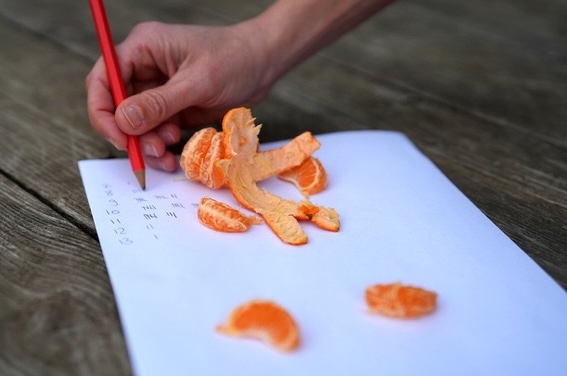
At the time of consumption, each fruit was peeled (typically without specialized equipment) and the number of edible segments was counted manually. Particular care was taken when small investigators were involved, as enthusiasm occasionally exceeded methodological restraint. Segment counts ranged from 7 to 13. Occasionally, relatives, friends, and colleagues contributed additional data, as enthusiasm for mandarin segment counting spread in a manner loosely reminiscent of seasonal viruses.
Analysis
Data were compiled as seasonal frequency tables. Weighted means, standard deviations, and distribution shapes were calculated descriptively. No mandarins were harmed beyond what was strictly necessary for nutritional purposes.
Results
Overall distribution
Across three seasons, 133 mandarins were analyzed. Segment number ranged from 7 to 13, with a clear unimodal distribution centered at 10 segments.
The pooled mean was: 9.79 ± 1.20 segments
Approximately 80% of fruits contained between 9 and 11 segments, indicating that while mandarins are not perfectly regimented, they show a strong preference for architectural moderation.
Temporal stability
Seasonal means were highly similar:
- 2023/24: 9.71
- 2024/25: 9.82
- 2025/26: 9.82
Thus, despite ongoing advances in citrus breeding and continued household exposure, the mandarin appears resistant to meaningful numerical drift.

Discussion
This three-year household investigation indicates that mandarin segment number is a notably conservative morphological trait. While individual fruits exhibit modest variability, the overall distribution remains tightly centered around 10 segments and stable across years.
Breeding has changed many things, just not this.
Modern citrus breeding has successfully delivered numerous consumer-friendly innovations, including reduced seed burden, improved peelability (even for small children), and enhanced sweetness profiles. Yet the internal segmentation pattern appears largely unchanged. Historical surveys from the late 20th century report very similar central tendencies (Tisserat, 1990), suggesting that breeders have either been unable or insufficiently motivated to substantially re-engineer mandarin internal architecture.
Split or fuse?
Our data cannot definitively resolve whether deviations from 10 segments arise primarily through carpel splitting or fusion. However, the roughly symmetric spread around the mode and the absence of extreme outliers suggest that mandarins may employ both strategies sparingly and without dramatic enthusiasm. Future work involving floral meristem imaging, genetic analysis, or very patient fruit dissection may clarify this point.
Developmental conservatism in a peelable world
The persistence of near-constant segment numbers despite extensive modification of other fruit traits is consistent with the broader biological concept that some structural features are developmentally buffered. In practical terms, mandarins appear willing to become sweeter, seedless, and easier to peel—but not radically reorganized internally.
Conclusion
Mandarins consumed under typical European winter conditions exhibit modest variation in segment number but maintain a strikingly stable distribution centered around 10 slices. This consistency has persisted despite decades of breeding efforts that successfully removed seeds, improved sweetness, and rendered the fruit peelable even by small children. The internal architecture of the mandarin therefore appears unusually resistant to innovation. In a produce landscape characterized by rapid optimization, the mandarin remains a quietly conservative object—abundant, convenient, and only mildly adventurous in its geometry. Whether future breeding programs will eventually persuade it to reconsider its numerical preferences remains, at present, uncertain.
References
Barry, C. S., & Giovannoni, J. J. (2007). Ethylene and fruit ripening. Journal of Plant Growth Regulation, 26(2), 143–159. doi.org/10.1007/s00344-007-9002-y
Bowman, J. L., Smyth, D. R., & Meyerowitz, E. M. (1991). Genetic interactions among floral homeotic genes of Arabidopsis. Development, 112(1), 1–20. doi.org/10.1242/dev.112.1.1
Ferrándiz, C., Fourquin, C., Prunet, N., et al. (2010). Carpel development. Advances in Botanical Research, 55, 1–73. doi.org/10.1016/B978-0-12-380868-4.00001-6
Spiegel-Roy, P., & Goldschmidt, E. E. (1996). Biology of Citrus. Cambridge University Press. doi.org/10.1017/CBO9780511600548
Tisserat, B., Galletta, P., & Jones, D. (1990). Carpel polymorphism in Citrus fruit. Botanical Gazette, 151(1), 54–63. doi.org/10.1086/337805