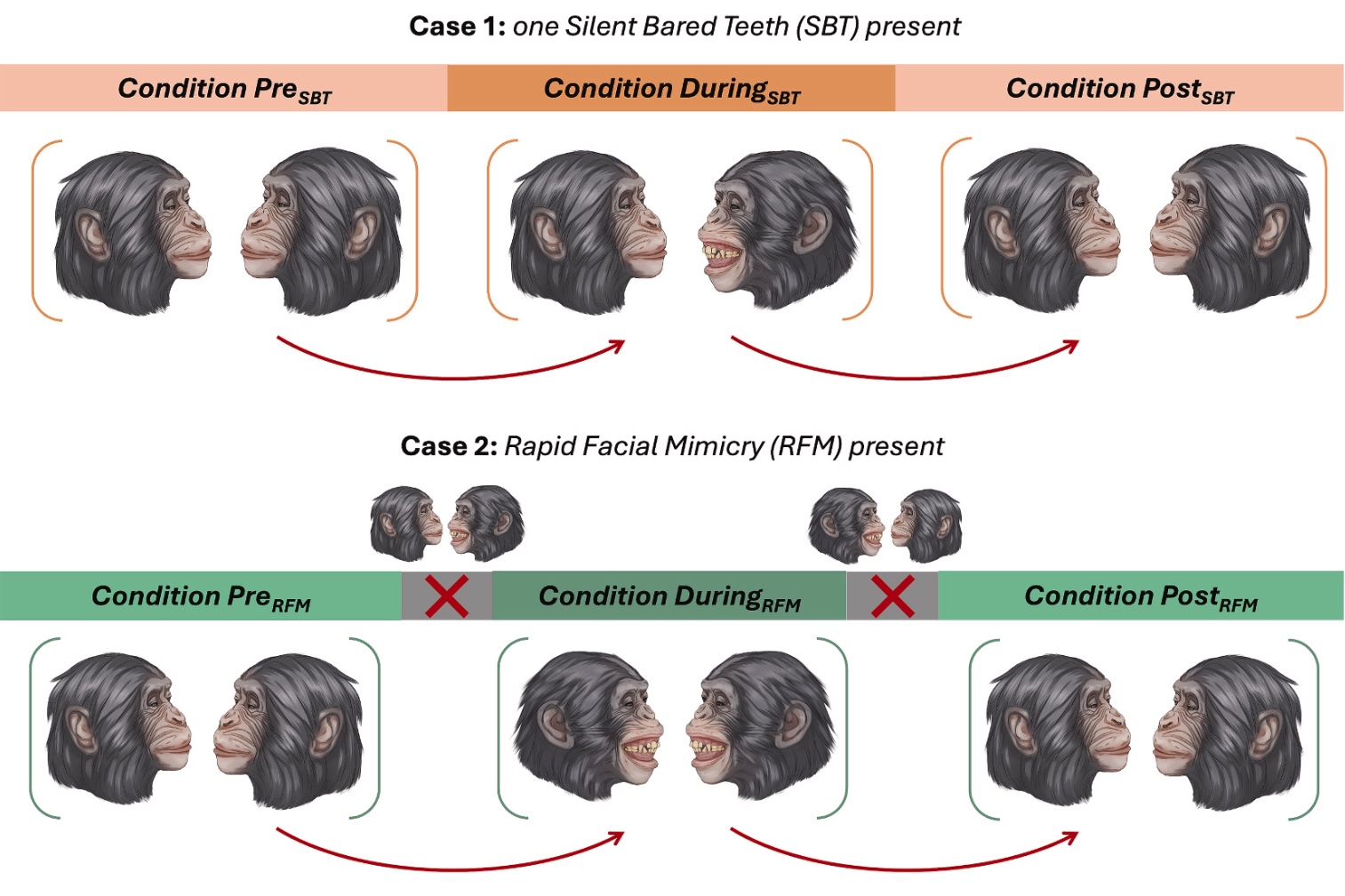
Silent bared-teeth and rapid facial mimicry come to the fore, in this new study about what can happen when two participants face off during sex, when and if those two participants are bonobos. The study is:
“SEX in Bonobos: The Intensity of Sexual Stimulation Sharply Drops After Facial Mimicry,” Martina Francesconi, Alice Galotti, Yannick Jadoul, Federico Giovannini, Andrea Ravignani, and Elisabetta Palagi, Evolution and Human Behavior, vol. 47, no. 1, January 2026, article 106786.
The authors do not explain why they chose to spell the word “SEX” in all uppercase letters. Perhaps there is no need to explain.
The authors are, variously, at the University of Pisa and Sapienza University of Rome, in Italy; Vrije Universiteit Brussel, in Belgium; and Aarhus University, Denmark, explain this, using technical language:
“Nonverbal communication plays a central role in human sexual interactions, enhancing sexual satisfaction and perceived partner connectedness. Here, we [examine] the role of facial displays in sexual interactions in bonobos (Pan paniscus), a species in which – unlike many others – sexuality serves both reproductive and social functions. Using high-resolution temporal analyses, we tested whether variations in the rate of the oscillatory movements during sex (a proxy for sexual stimulation intensity) are associated with the exchange of facial expressions, specifically silent bared-teeth (SBT) displays and rapid facial mimicry (RFM). Analyses of sexual sessions free from interference by third-parties revealed that the offset of unilateral SBTs was not followed by a significant decrease in the oscillatory movement rates, whereas the termination of RFM consistently triggered a decline in sexual stimulation. Restricted temporal windows surrounding RFM cessation further confirmed that disruption of facial mimicry by even one partner suffices to decrease stimulation intensity. These results indicate that RFM, rather than passive observation of a partner’s expression, marks the peak of sexual stimulation and reflects fine-grained socio-emotional coordination between partners.”