“One bright spot amid the gloom surrounding the state of scientific research in Japan is the fact that the nation keeps winning the Ig Nobel Prize, a parody of the Nobel Prize, whose aim is to “honor achievements that first make people laugh, and then make them think.” Japanese scientists have been among the Ig Nobel winners for 18 straight years.”
So begins a December 2, 2024 report in The Japan Times. It continues:
This year, a team of scientists led by Takanori Takebe, a professor at the Osaka University Graduate School of Medicine and the Institute of Science Tokyo, received the award in physiology for “discovering that many mammals are capable of breathing through their anus.”
Takebe confesses that he had mixed feelings about the award when he was first notified by the organizers. “We don’t consider our research humorous,” he says. But in the end, he attended the award ceremony at the Massachusetts Institute of Technology in September donning the hat of a loach, a fish that can breathe through its intestines and which inspired him to study the possibility of intestinal breathing in mammals.
Takebe says there is probably no serious reason why Japanese researchers keep getting Ig Nobels, speculating that they get noticed through nominations from past winners. But he adds that, because of the language barrier and the “Galapagos effect” in academia, some scientists in Japan may be able to remain aloof to international trends, which allows them to pursue unique research.
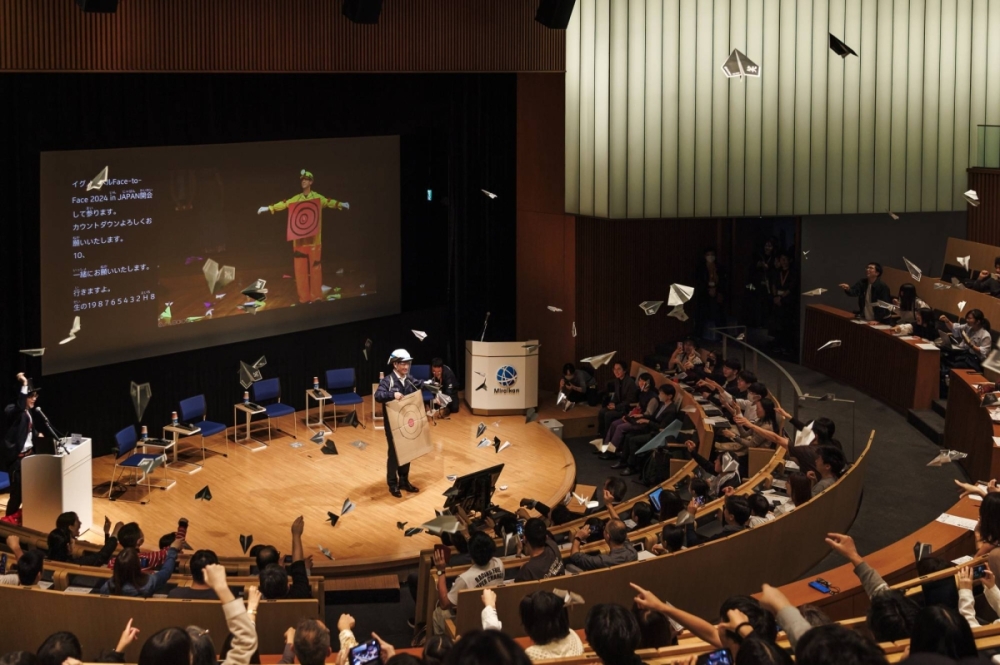
At a recent official Ig Nobel event in Japan, a local version of the Ig Nobel Face to Face event held in the U.S., joyous vibes filled the lecture hall at Miraikan, a popular science museum in Tokyo’s Odaiba district. [The photo, above, has this caption: “The Miraikan Ig Nobel event included the same paper plane opening ceremony as the original in the United States. | ANNA PETEK”]
Takebe, two past Ig Nobel winners and Takaaki Kajita, who was awarded the 2015 Nobel Prize in physics, appeared on stage together — taking on the challenge of explaining their research plainly and entertainingly in front of an audience of non-experts, including many children, in under five minutes.
A few of the speakers went over their allotted time, perhaps intentionally to draw a laugh. They were inevitably cut short by a cymbal hit by a schoolgirl, similar to how the 8-year-old Miss Sweetie Poo in the U.S. Ig Nobel award ceremony cuts off award acceptance speeches by declaring, “Please stop, I’m bored.”
Backstage after the fun-filled event, Takebe got serious as he talked about Stellar Science Foundation, a nonprofit group he set up in 2021 to support the next generation of scientists with the potential to become “disruptive inventors.”
The foundation has held numerous events, including retreats, where early career researchers across different fields get together over two days to present their research, exchange ideas and engage in quick pitch sessions.
At the same time, however, Takebe says he is struggling to secure funding for the very research he received the Ig Nobel award for: intestinal breathing.
A company he founded had begun a clinical trial to test the efficacy of a medical device that would allow people who have difficulty breathing through their lungs to receive oxygen-rich liquid through the rectum. But funding for the costly clinical trial was cut off by a government agency just a few months into the project, on the grounds that the device’s prospects for real-world use were not clear enough, Takebe says.
“There’s no other device like this in the world — it offers a completely new paradigm,” he says. “So I understand how the funders may get cautious. But to find out the marketability of a device, you need to do more research.
“If you only fund research that is already hot elsewhere in the world, how can we create something genuinely new?”