Marijuana improves night vision of tadpoles, suggests a newly published study: “Endocannabinoid signaling enhances visual responses through modulation of intracellular chloride levels in retinal ganglion cells,” Loïs S Miraucourt, Jennifer Tsui, Delphine Gobert, Jean-François Desjardins, Anne Schohl, Mari Sild, Perry Spratt, Annie Castonguay, Yves De Koninck, Nicholas Marsh-Armstrong, Paul W Wiseman, and Edward S Ruthazer, eLife, 2016;5:e15932.
The authors, at McGill University, Canada; University of La Verne, United States; University of California, San Francisco, United States; Université Laval, Canada; Johns Hopkins University School of Medicine, United States; Kennedy Krieger Institute, United States, report:
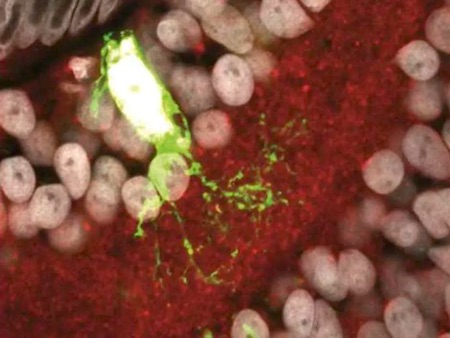
“Type 1 cannabinoid receptors (CB1Rs) are widely expressed in the vertebrate retina, but the role of endocannabinoids in vision is not fully understood. Here, we identified a novel mechanism underlying a CB1R-mediated increase in retinal ganglion cell (RGC) intrinsic excitability acting through AMPK-dependent inhibition of NKCC1 activity. Clomeleon imaging and patch clamp recordings revealed that inhibition of NKCC1 downstream of CB1R activation reduces intracellular Cl− levels in RGCs, hyperpolarizing the resting membrane potential. We confirmed that such hyperpolarization enhances RGC action potential firing in response to subsequent depolarization, consistent with the increased intrinsic excitability of RGCs observed with CB1R activation. Using a dot avoidance assay in freely swimming Xenopus tadpoles, we demonstrate that CB1R activation markedly improves visual contrast sensitivity under low-light conditions.”
Charlie Fidelman provides further details, in the Montreal Gazette, under the headline “Pot improves night vision — in tadpoles, study finds“.
(Thanks to Christie Rowe for bringing this to our attention.)
BONUS (Distantly related): The 2000 Ig Nobel Prize for biology was awarded to Richard Wassersug of Dalhousie University (now at U British Columbia) for his first-hand report, “On the Comparative Palatability of Some Dry-Season Tadpoles from Costa Rica.” [Published in The American Midland Naturalist, vol. 86, no. 1, July 1971, pp. 101-9.]
