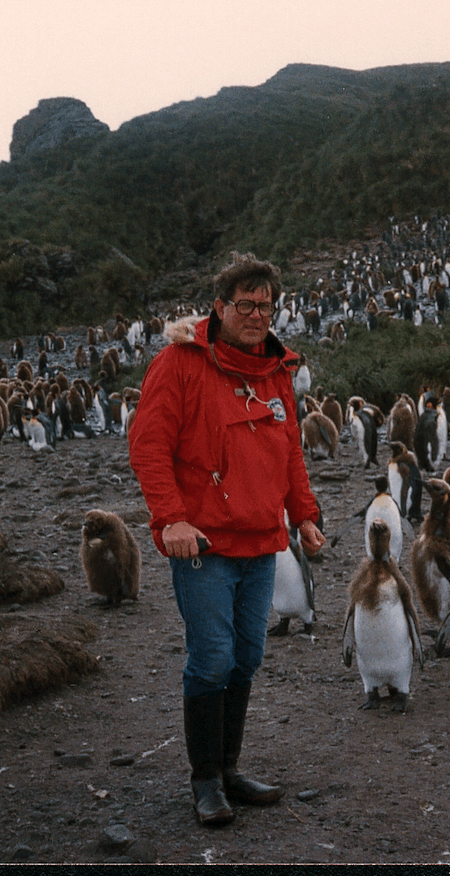
Investigator John Splettstoesser [pictured here — click on image to see an enlargement] writes:
 The popular movie “March of the Penguins,” a true-life story of the breeding cycle of Emperor Penguins, and a related movie “Happy Feet,” an animated movie about dancing penguins focused on an environmental theme, has shown that indeed penguins do march and they also dance. In addition, when they do so, they also create music. In a study sponsored by the U.S. National Science Foundation’s Office of Polar Programs (OPP), a composer who specializes in musical sounds produced by unconventional sources such as pinecones and shards of glass, box spring mattresses, and circular saw blades, as examples, visited selected locations in Antarctica to conduct what is probably a one-of-a-kind project. Sounds produced by penguins, icebergs and other natural features were the targets of study by the composer as a means of applying them to ‘music’ after returning to the U.S. It already sounds like something that Spike Jones once produced, but read on.
It should be noted (for the benefit of American taxpayers) that the composer was the recipient of an NSF Artists and Writers (A&W) Program grant, designed for what the words say, and not a research grant that the U.S. Antarctic Program awards for ‘hard’ science. In the defense of A&W recipients, some of the finest photography, artistry, and books have resulted from those awards, for example. From 1975 to 1988, Senator William Proxmire (D-Wisconsin) might have called this study a “Golden Fleece Award,” without regard to the sophisticated nature of one of a series of A&W awards that illustrate that Antarctica has much to offer besides basic and applied research.
Music, you say? Considering what is produced by some rock music stars and others, perhaps that related to penguins is not so far off. It isn’t really the birds that produce music, but what is produced when they walk on small polished stones at one of their breeding sites in Antarctica, a place called Torgersen Island, adjacent to the U.S. station called Palmer. These stones, or pebbles, have been polished over a period of many years, perhaps centuries, on pathways that the penguins use to travel to the sea for feeding and return to their nests each austral summer. By tumbling the pebbles with their feet as they walk to and from the sea, the combination of that movement, along with the naturally occurring agent found in all penguin colonies called ‘penguin guano’ (a sort of polishing agent that smells), the polishing is developed to the point that when the birds walk over them, melodious sounds are produced, similar to coins falling together in a pile. A lapidary uses the equivalent of guano as a grinding powder when tumbling agates to highlight surface features. I have visited Torgersen Island and many others where penguin nesting sites are located, and noticed the same audible feature, which can also be produced by my own feet as I walked across those polished pebbles.
So how long have penguins been rock music stars (no pun intended)? Penguins have been around for millions of years, implying that their specific kind of music has longevity. How many current rock music stars can say that?