Because hydrogen is an explosive gas, to do large-scale testing Taguchi needs to get permission from the Fire and Disaster Management Agency. And to date, the agency has denied him that permission, citing as the reason: “We haven’t given such permission before.” However, with his Ig Nobel Prize, the professor hopes there will now be more chance of his discovery becoming widely known. To set that process in motion, on Oct. 3 he gave a five-minute presentation at an event titled “Ig Informal Lectures” that was held at the Massachusetts Institute of Technology.
“Feces from panda, and termites, have given us wondrous gifts of bacteria that can benefit us all through a new waste-processing technology that also contributes to the fight against global warming,” Taguchi told his MIT audience, adding rather triumphantly: “This is feces innovation.”
Sure enough, since receiving his Ig Nobel Prize, the professor has received many inquiries from media outlets in Japan and overseas. But to his chagrin, he says that not a single local government in Japan, has contacted him for help with waste disposal.
Perhaps, though, Taguchi’s Ig Nobel Prize — awarded for an achievement that “first makes people laugh and then makes them think” — will one day lead movers and shakers in the world of waste to cease snickering and instead make serious inquiries.
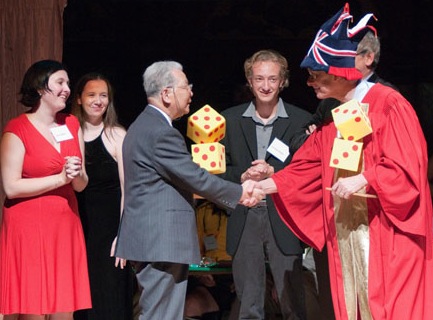
That’s part of the Japan Times interview with Professor Fumiaki Taguchi, who was awarded the 2009 Ig Nobel Biology Prize for demonstrating that kitchen refuse can be reduced more than 90% in mass by using bacteria extracted from the feces of giant pandas.