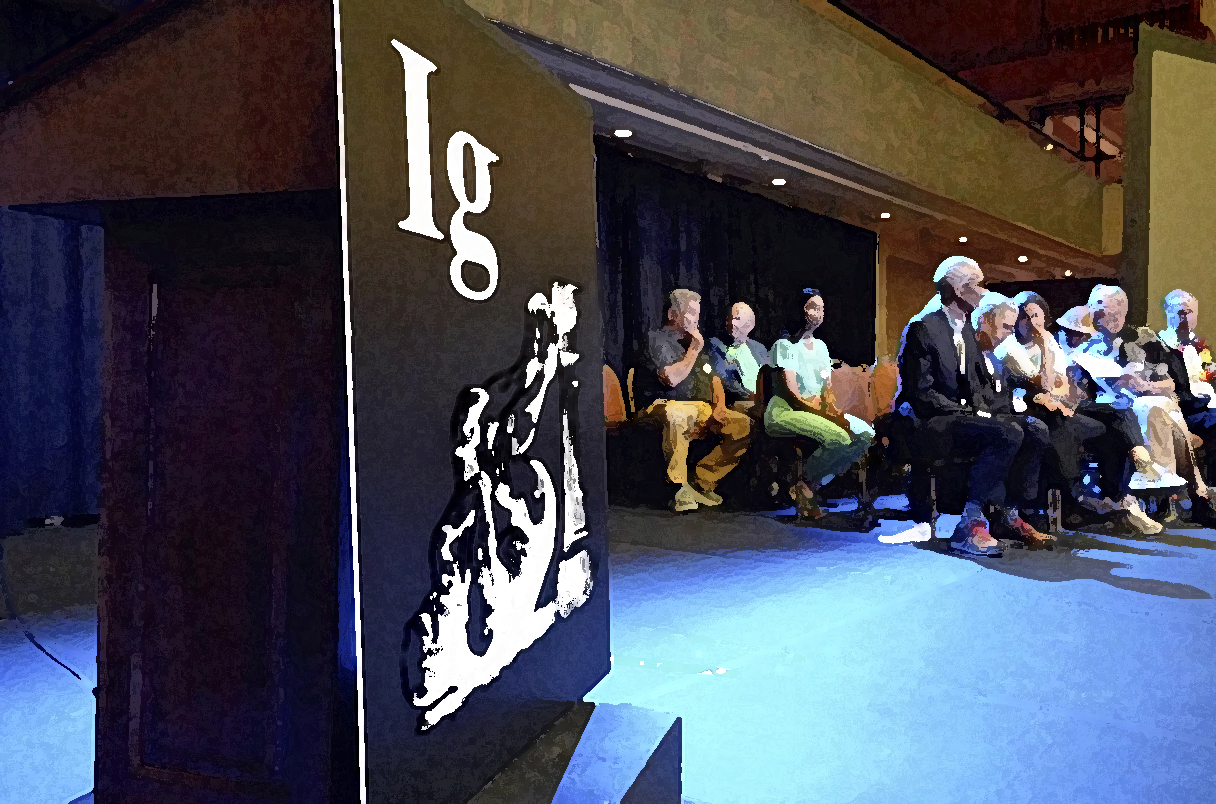
This year, this 2025, brought new difficulties in organizing the Ig Nobel Prize ceremony — difficulties for us, the ceremony organizers, and difficulties for the winners who contemplated traveling to the USA to take part in the ceremony. Hannah Richter reports about it in a September 19 article in Science magazine:
The Ig Nobels are science’s most lighthearted event. This year is ‘not typical’
Amid Trump research cuts, visa restrictions, and international conflicts, some winners sit out the celebration of whimsical science
In a Viennese pub in 2013, a group of experimental psychologists jokingly agreed they were better at speaking foreign languages after a drink. They later decided to investigate their hunch—and to their surprise, the resulting study confirmed their tipsy inkling.
More than a decade after that fateful night out, the researchers have now received science’s most whimsical and notorious honor: an Ig Nobel Prize. But the psychologists did not make it to the prize’s 35th annual award ceremony in Boston—and neither did three of the other nine winning teams. In all, nearly half of this year’s Ig Nobel recipients declined to attend. Wars, visa restrictions, and the research and border policies of U.S. President Donald Trump’s administration have all dampened the fun.
The situation has “been really agonizing for us,” says Marc Abrahams, founder and master of ceremonies of the Ig Nobels and editor of the Annals of Improbable Research, a scientific humor magazine. “We’ve been trying, with the winners, to simultaneously make it clear that we’re really eager to have [them] here … but we want [them] to be safe and comfortable.”
Historically, winners of the Ig Nobel, which celebrates science that “makes people laugh, then think,” have paid their own way from places as far as Australia, Japan, and Argentina to join an in-person ceremony featuring 24-second lectures and a barrage of paper airplanes. Abrahams says all but one of this year’s winning teams initially told him they were eager to attend. In the weeks leading up to the ceremony, however, many changed their minds.
For Indian industrial designer Vikash Kumar, co-winner of this year’s engineering design prize for creating shoe racks that minimize stinky feet smells, the first barrier was travel expenses. But then he was haunted by an image circulating on the news, showing undocumented migrants from India being deported from the United States in shackles. “That made me really uncomfortable,” says Kumar, assistant professor at the Shiv Nadar Institution of Eminence, and “may be the underlying reason of not traveling.”
Even if they had wanted to attend, adds Kumar’s co-winner Sarthak Mittal, a software engineer at Newgen Software and Kumar’s past undergraduate research assistant, obtaining a U.S. travel visa from India now takes 7 to 8 months, far longer than they had to plan for the ceremony. Instead, Kumar has invited Mittal for a small party at his university. “Despite limitations, we Indians are good at celebrating things,” Kumar says.
U.S. politics also deterred the team that studied drunken foreign language abilities and notched the peace prize. Fritz Renner, a clinical psychologist now at Germany’s University of Freiburg, could not put aside how “the government [is] meddling into the funding and trying to influence the freedom and free speech of the universities.” And they, too, worried about trouble at the border. Jessica Werthmann, also a clinical psychologist and Renner’s wife and co-winner, says that with three young children at home in Germany, the pair did not want to risk getting stuck in the U.S.
Turmoil abroad shadowed this year’s event, too. Marcin Zajenkowski, a Polish psychologist at the University of Warsaw, won the psychology prize for finding that telling people they were intelligent boosted their narcissism. Although he did make the trek to Boston, he worried about flying with the Russia-Ukraine war so close by. Earlier this week, Polish authorities closed down the country’s airspace because of infringing Russian drones. “There is a great uncertainty right now,” he says.
A team including Berry Pinshow, a biophysical ecologist at Israel’s Ben-Gurion University of the Negev, received this year’s aviation prize for showing that alcohol impairs bats’ flight and echolocation. But Pinshow and his Israeli colleague decided not to attend the ceremony, in part because of health and family matters and in part out of concern that their presence would draw external demonstrations or stoke attendees’ discomfort over the Israel-Hamas war. “In the current political atmosphere, we did not feel it appropriate to travel,” Pinshow says.
Instead, the team sent Francisco Sánchez, an ecologist from Colombia who decided to bring his family for vacation, and Maru Melcón, a biologist and naturalized U.S. citizen originally from Argentina. “There are problems in the world, and there’s science also happening,” Melcón says of the event. “It’s a matter of where you focus, and I’m choosing to be present.” (In the end, Melcón did not make it to Boston, after her flight was canceled because of an emergency at San Diego International Airport.)
The missing winners, including those absent for fieldwork and scheduling, will have another chance to celebrate their awards, Abrahams says. Having anticipated some difficulties with the U.S. ceremony, Abrahams has already begun to plan three other events for winners in the coming months in London, Berlin, and Tokyo. All of the winning teams that did not travel to the main ceremony in Boston hope to attend at least one.
At a time when U.S. scientists feel besieged, this year’s Ig Nobels carry a special weight, says Julie Mennella, a biopsychologist at Philadelphia’s Monell Chemical Senses Center who won this year’s pediatrics prize for finding in the 1990s that babies whose mothers ate garlic during pregnancy enjoy the taste of it when nursing. Scientists shouldn’t forget “the thrill of discovery” and “the joy” that come from basic experimental research. She adds that the pursuit of one’s seemingly silliest ideas—the kind inquiry the Ig Nobels honor—represents “freedom at its best.”