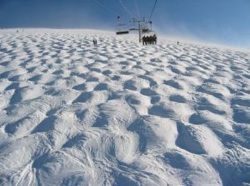
 A new physics analysis echoes, in a way, the message brought to MacBeth in act 5, scene 5:
As I did stand my watch upon the hill,
I look’d toward Birnam, and anon, methought,
The wood began to move.
Actually, trees almost always stay put. But when there’s snow, the bumps (called “moguls”) sometimes do move uphill. A study by three researchers in Colorado explains:
“The Surprising Motion of Ski Moguls,” David B. Bahr, W. Tad Pfeffer, and Raymond C. Browning, Physics Today, November 2009, page 68. (Thanks to Dave Brooks and Granite Geek for bringing it to our attention.) The authors report that:
Regularly spaced bumps that arise on ski slopes defy intuition by migrating uphill, even though skiers and snow move downhill…. If we estimate that N ≈ 100 skiers are enough to generate bumps of the critical size, then h/a ≈ 10. The critical height, then, is about 10 times that of the erosion–deposition amplitude, roughly 0.1 m for hard-packed snow. Once the proto-moguls have formed, skiers tend to turn on the downhill side. That preference slowly realigns each bump’s position until moguls have organized into the classic checkerboard pattern.
UPDATE: Videos of moguls on the move.