



After 35 years in the USA, the Ig Nobel Prize ceremony is moving to Europe. This coming September 3, the 36th First Annual Ig Nobel Prize Ceremony will take place in Zurich, Switzerland. TICKETS TICKETS TICKETS will go on sale Tuesday, May 12, 2026, at 10 am (CET), here at http://www.improbable.com
[NOTE: We will also have a (much smaller) celebration event in Cambridge, Massachusetts, USA, three weeks after the ceremony happens in Zurich!]
Ig Nobel Prizes honor achievements that make people LAUGH, and then THINK. Organized by the magazine Annals of Improbable Research (AIR), they celebrate the unusual, honor the imaginative, and spur interest in science. Winners travel to the ceremony from around the world, to collect their prizes and be showered with paper airplanes. The first 35 ceremonies (1991-2025) all took place in Massachusetts: at Harvard University, MIT [The Massachusetts Institute of Technology], and Boston University. But now the ceremony is moving to Europe.


WHY
Marc Abrahams, founder and emcee of the ceremony (and editor of the magazine), explains: “During the past year, it has become unsafe for our guests to visit the country. We cannot in good conscience ask the new winners, or the international journalists who cover the event, to travel to the USA this year.”
This year’s ceremony is being produced in collaboration with institutions of the ETH Domain and the University of Zurich. Abrahams explains: “The city of Zurich and its institutions rapidly moved mountains (only metaphorically — in Switzerland it is illegal to physically move mountains) and committed to make this possible. Switzerland has nurtured many unexpected good things —Albert Einstein’s physics, the world economy, and the cuckoo clock leap to mind — and is again helping the world appreciate improbable people and ideas.”
Switzerland is a country that invests heavily in education, research, and innovation, and thus also in imparting knowledge to the wider population. It has no exportable resources, except perhaps cheese and chocolate, and relies on education and innovation. “The Ig Nobel Prize makes research visible, and does so with a wink,” says Milo Puhan, epidemiologist at the University of Zurich and Swiss Ig Nobel Prize winner in 2017. His study received a great deal of attention. “My research showed that playing the didgeridoo trains the muscles and structures that keep the upper airways open, thereby reducing nighttime snoring and the severity of sleep apnea syndrome.”


THE LONG-TERM INTERNATIONAL PLAN
For the future, the general plan is to hold the ceremony in Zurich this year, and again every 2nd year, thus in 2028 again. Each interim year — each odd-numbered year —the ceremony will be hosted in a different city. “In that respect,” says Abrahams, “it will be a little like the Eurovision Song Contest with a base in Zurich.”
Cities in Europe and elsewhere are formulating plans to host webcast-watching parties this year.
THE PRIZES AND THE CEREMONY
Ten (10) new Ig Nobel Prizes are awarded each year. The identities of the winners are kept secret until they receive their prize during the ceremony. A gaggle of amused genuine Nobel laureates physically present the prizes to the Ig Nobel Prize winners.
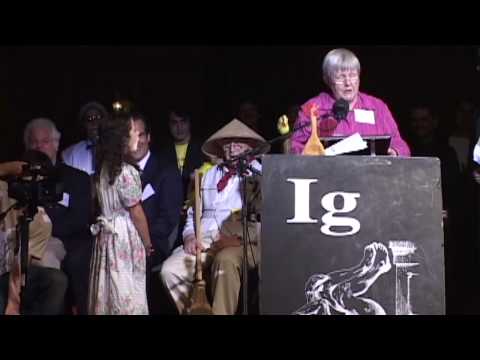
The ceremony includes quirky, beloved traditions. Among them: paper airplanes thrown by the audience; innovative techniques to ensure that speeches are brief (traditionally, an eight-year-old child tells anyone who talks too long to “Please stop. I’m bored. Please stop. I’m bored. Please stop. I’m bored….”); music performed by scientists and opera singers; and the 24/7 Lectures (in which several of the world’s top thinkers each explains their subject twice — first in 24 seconds, and then, clearly, in seven words).
Last year (2025) the ten Ig Nobel honorees included:
- the doctor who persistently recorded and analyzed the rate of growth of one of his fingernails over a period of 35 years
- the psychologists who studied what happens when you tell narcissists — or anyone else — that they are intelligent
- the biologists who tested whether cows painted with zebra-like striping can avoid being bitten by flies
- the physicists who discovered a truth about the physics of pasta sauce
THE CAMBRIDGE (MASSACHUSETTS) CELEBRATION (3 weeks after the Zurich ceremony)
Abrahams emphasized that the Ig Nobel Prizes are not abandoning the USA: “We are merely ensuring that the winners can travel and meet. Despite the current strange winds, science and scientists and the public’s love of science are very much alive and kicking in the USA.”
This autumn, 2026, we very much WILL have an event in Cambridge to celebrate the Ig Nobel Prizes — but this new Boston celebration will be of a different nature. Three weeks AFTER the winners are introduced at the Zurich ceremony, we’ll have a nocturnal gathering with:
-
- ultra-short talks by past Ig Nobel Prize winners
- science songs by Tom Lehrer
- science-related paintings from the Museum of Bad Art (MOBA)
Here is the main message of the September 24 celebration in Cambridge: The bizarre attacks on science will not utterly destroy science in the USA. American scientists and the American public, undaunted, both support and enjoy(!) the grand adventure of science.
THE CEREMONY & WEBCAST
The 2026 ceremony will be webcast. (This will be the 32nd straight year — the 1995 Ig Nobel ceremony was one of the very first events ever to be webcast). Webcast watch parties will happen in many countries.
WHAT: The 36th First Annual Ig Nobel Prize ceremony
WHEN: Thursday, September 3, 2026
WHERE: Zurich, Switzerland
TICKETS to attend the ceremony will go on sale May 12, here at www.improbable.com
RELATED EVENTS
WHAT: The Spring 2026 Ig Nobel EuroTour
As usual, several past winners of the Ig Nobel Prize will appear in public events in Europe.
WHEN: April and May, 2026
WHERE: Germany, Sweden, Switzerland, Greece, The Netherlands
DETAILS: The EuroTour schedule is at improbable.com/upcoming-events
WHAT: BOST-IG — a celebration of past and new Ig Nobel Prizes, the songs of Tom Lehrer, the Museum of Bad Art, and American science
WHEN: Thursday, September 24, 2026
WHERE: Swissnex, Cambridge, Massachusetts, USA
DETAILS: TBA
BACKGROUND INFO
- IG NOBEL PRIZES INFO
- LIST OF ALL PAST IG NOBEL PRIZE WINNERS
- DETAILS (INCLUDING VIDEO) OF PAST CEREMONIES
SOME REACTIONS
Dip into some of the press reports about this, if you like!
Good places to start: The Spanish newspaper El País did an especially detailed interview [“the essence of the Ig Nobel Prizes is to get people to pay attention to things they thought they’d never care about”] about all this. The Hungarian news organization Index wrote a fairly extensive analysis [“Marc Abrahams’ decision to found the institute is not a symbolic gesture: it reflects a real crisis in American science.”].
Some Updates (bits of new news)
- April 3, 2025: THE CEREMONY LOGO: Keira Lee Rice created the evocative logo for this year’s Ig Nobel Prize ceremony. You can see it at the top of this blog post.
- April 4, 2025: VOLUNTEER TO HELP AT THE CEREMONY: Anyone who would like to volunteer to help at the 36th First Annual Ig Nobel Prize Ceremony (in Zurich in September) can meet with ceremony organizers Marc Abrahams and Mirko Bischofberger, to explore the possibilities. We’ll meet up on Saturday, April 25, 2026, from 10:00 am – noon — at ORBIZ Josef, Josefstrasse 214a, 8005, Zürich, SWITZERLAND.