


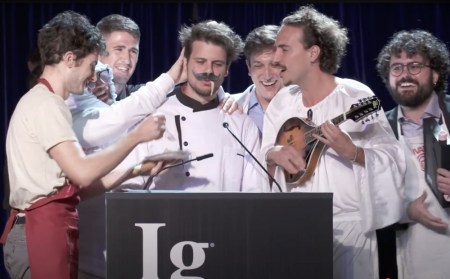
One way to make it big in physics is to make pasta. Physics Magazine interviewed the Italian physicists who did exactly that — and consequently won the 2025 Ig Nobel Prize for physics.
Here is the beginning of that interview (read the whole interview at the Physics Magazine web site):
Pasta Physics Scoops Up an Ig Nobel Prize
September 19, 2025• Physics 18, 163
A group of Italian physicists was awarded the Ig Nobel Prize in Physics for their study of the phase diagram of a cheesy sauce renowned in Italy.
The Ig Nobel Prize ceremony took place last night in Boston, with all the kooky fanfare that this science awards show is famous for (see Feature: Science as a Laughing Matter). This year, the Ig Nobel Physics Prize went to a group of Italian physicists “for discoveries about the physics of pasta sauce, especially the phase transition that can lead to clumping, which can be a cause of unpleasantness.”
The study focused on a traditional Italian sauce called cacio e pepe, which, as the name suggests, is just two ingredients: pecorino Romano cheese and cracked pepper, stirred together with some of the starchy water from cooking the pasta to create an emulsion. Deceptively simple sounding, the preparation of this sauce is notoriously difficult, as the cheese has a tendency to aggregate into chewy, unsightly clumps.
In the experiments, the Italian team investigated a well-known kitchen trick—enhance emulsification by adding cornstarch to the water. From their measurements of the phase behavior, the researchers came up with a scientifically precise recipe that can avoid the dreaded clumpiness (see Research News: Cooking Flawless Pasta). Physics Magazine sat down for a virtual chat with some members of the team: Giacomo Bartolucci, Daniel Maria Busiello, Matteo Ciarchi, Ivan Di Terlizzi, and Vincenzo Maria Schimmenti. We asked them how they were savoring their culinary triumph.
All interviews are edited for brevity and clarity.
What was your initial reaction to hearing that you won an Ig Nobel prize?
Schimmenti: We were contacted by a previous Ig Nobel winner, Andrea Rapisarda, who told us that our work had been selected. The funny thing is, he asked us if we were okay with accepting the prize. It took a second for the question to sink in. But we screamed, “Of course!” We were very happy to have our work honored in this way.
When you were working on your pasta study, did you think it might be a contender for an Ig Nobel Prize?
Di Terlizzi: I have to say that I had a hope. But you know, Italians are superstitious. We don’t really like to say things out loud before they happen. It was great when it became a reality.
How did you get started on this problem of making cacio e pepe?
Di Terlizzi: We were all at one point working together at the Max Planck Institute for the Physics of Complex Systems in Germany. One of our favorite hobbies was to invite a big group of people and cook Italian dishes, like fettuccine carbonara and spaghetti alla puttanesca. But some guests asked why we didn’t make cacio e pepe. My answer was that cacio e pepe is basically impossible to do for a lot of people. And that’s because you need to use more heat for large quantities. And with the heat, you risk the sauce becoming clumpy and unpleasant to eat. But as scientists, we wondered why this clumping happens.
Why might physicists be interested in the clumping?
Bartolucci: It’s an example of phase separation, in which parts of a mixture congeal together spontaneously. We all work in biological physics, and one of the main discoveries in this field is that cells exhibit phase separation, in which a “clump” of proteins inside the cell will separate from the surrounding fluid. We have plenty of physics tools at hand to study phase separations, so we decided to apply that expertise to pasta sauce….