


Now a follow-up study, carried out by Shamik Dholakia, Jonathan Buckler, John Paul Jeans, Andrew Pillai, Natasha Eagles and Shruti Dholakia at the Milton Keynes General Hospital, Buckinghamshire, UK, based on 3850 returned questionnaires over a period of ten years, confirmed the decreasing incidence of pubic lice infestations and links this demise strongly to pubic hair removal practices. In their report ‘Pubic Lice: An Endangered Species?’ published recently in Sexually Transmitted Diseases 41(6): 388-391, they state, firmly:
Results: A significant and strong correlation between the falling incidence of pubic lice infections and increase in pubic hair removal was observed.
Conclusions: The increased incidence of hair removal may lead to atypical patterns of pubic lice infestations or its complete eradication as the natural habitat of this parasite is destroyed.
However, they still see a future for the species:
As culture and practice changes, we may see a changing atypical pattern of pubic lice infestations, as they try to colonize other habitats such as chest or eyebrow hair.
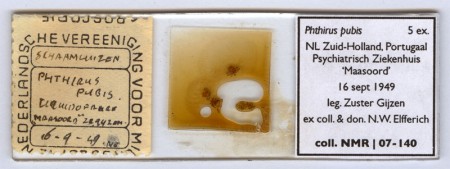
BONUS: A well preserved sample of Dutch specimens of Pthirus pubis, kept in the collection of the Natural History Museum Rotterdam, from 1949 when they had nothing to fear:
And here is some history: my own hunt for pubic lice specimens, in 2007.
